Showing posts with label facts. Show all posts

Sunday, August 31, 2008

"HENS GRANTED AMNESTY"

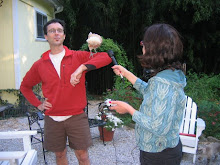
My parent's rather traditional pets, Muffy & Joe, nervously await the chicken decision. Unfortunately my sister Julia and her husband Greg were in Denver for the DNC and could not make the chicken meeting.
On Thursday Sewanee's local paper the Mountain Messenger printed the following report on this week's Community Council meeting:


"Katherine Alvarez, manager of Stirling's Coffee House, has lived in Sewanee for 30 years and in the same house on University Avenue for 13 years. She has kept chickens in her backyard for the past two years and has three pet hens: Antoinette, a Frizzle; Chloe, a Polish and Alysa, a bantam Cochin. Though Alvarez does not own a rooster, this summer one of her neighbors lodged a complaint about noise with the lease committee, which referred the problem to the Community Council. Alvarez's father, Laurence, started the discussion on Monday evening by saying the University's lease agreement prohibits livestock on the Domain, yet all the definitions of livestock he has researched do not include chickens. [the Tenn. Department of Agriculture's definition: "Livestock is defined as cattle, equine, swine, sheep or goats."] He said Katherine's chickens are not running around freely in the front yard and are not bothering anyone.

According to Alvarez, her chickens make less noise than dogs, cicadas, tree frogs, children or alumni. They live in a children's play house and adjacent screened-in porch, and when she lets them out into the backyard, deer netting around the yard keeps dogs and other animals out. For photos of Alvarez's chickens, her house, backyard and the chicken house, see <savesewaneechickens.blogspot.com/>.

Approximately 25 people attended the meeting in support of Alvarez. District 4 Representative Mary Blount said some of her constituents are concerned that too many chickens may be allowed on the Domain. She said, "The lease agreement was written to help us all live together. We should suggest to the University to refine it's definition of livestock."

As District 4 Representative Annie Armour could not attend the meeting, she asked Provost Linda Lankewicz to share her written opinion with the council: "I believe that as a community we should always look beyond traditionally accepted norms to new possibilities. In this case, there are lots of animals, including chickens, that are becoming socially acceptable as pets. Moreover, chickens fit into Sewanee's plan to become a leader in self-sustainability, too, since they eat ticks (thus helping one avoid spraying poisons in the yard) and provide eggs to eat. I think dogs can be much more of a nuisance than chickens, yet I would never ask that they be banished from the Domain. ... I do not see chickens as nuisances. They are not dangerous, noisy, vicious or particularly smelly. I do not see a compelling reason to ask Katherine to get rid of her chickens."

Professor of biology and Sustainabiliy Committee member David Haskell said that he and his wife had asked the Lease Committee's permission to keep their animals [including goats]. He and others on the Sustainability Committee are working on proposed revisions of lease rules to allow small-scale livestock for home consumption. Haskell said that the lease agreement says exceptions may be made if people present their requests to the Lease Committee. "I would hope we could allow some exceptions to allow animals for families to raise their own produce," he said.

District 1 representative Marymor (Boo) Cravens said, "What's the difference between an Easter bunny and a pet chicken?" She made a motion that the Community Council recommend that hens be allowed on the Domain subject to the Sustainability Committee's recommendations to the University and the Lease Committee; and the motion carried unanimously. Superintendent of Leases, Barbara Schlichting will present this recommendation to the Lease Committee at it's Sept. 17 meeting."

Wednesday, August 20, 2008

Box Turtles and "Underground Chickens"

Antoinette learns that turtles lay eggs too!As a gardener, I've had the privilege of watching a box turtle lay eggs in my flower bed twice. The most recent time was this summer. Even though I mark my calendar, I have yet to see the eggs hatch. While reading up on our local turtles, I learned that they want to stay within the same area where they were born. If one is moved more than a half-mile from its territory, it may never find its way back; but may spend years unsystematically searching. I feel TERRIBLE! When I used to see one on the side of the road, I would bring it home to show my children and then let it go in the yard. Now I understand why I don't have a yard full of turtles - they all set out trying to find their way back to the Jump Off Road! Over the span of their lifetime, female turtles will lay hundreds of eggs, but only 2-3 of these offspring will survive to adulthood. Wow. Who knew.

Today a recent graduate of the university came to visit me. He'd just returned from his 3rd summer helping people in a developing country and will go on to graduate school in Europe soon. He was a merit scholar, athlete, volunteer and all around great guy. Unfortunately he never expressed interest in marrying one of my daughters. He's been following the Sewanee chicken story and came to tell me about his mother's "underground chickens".

Apparently it's not exactly legal to keep them where he grew up. Nevertheless, his mother got four and her neighbor got two. The chickens wandered happily between the yards visiting - as chickens will do. I guess they wandered too far one day and someone complained. An official from the city was sent to deal with the problem. The chicken mothers said they would fence the birds in, but the official said he could not leave unless they promised to get rid of the hens. He didn't seem concerned with whether they actually removed them - just that they said they would. So, (these were very smart women) they said they would, fenced in the chickens and lived happily ever after.

Who DOESN'T have chickens???

Here's a link to a "stealth chicken coop" designed to look like a trash can. http://henspa.com/hencondo.htm

Wednesday, August 6, 2008

Nationwide Ordinances II

Naturally all these ordinances are pro chicken, but my last post was a little dry, so I've added comments...
Cincinnati - "No person shall confine any fowl in a crate, box, or other receptacle in a cramped or unnatural position ", "No person shall use any live, newly hatched fowl or bird as a toy " Who enforces these laws?

Monterey, CA - "Raising four or less chickens, rabbits, or other similar fowl or small animals is permitted as an accessory use." Gotta love California - so fashion conscious. More than four and they're no longer accessories.
Carlsbad, NM - " No chick, duckling, gosling or rabbit that has been dyed or otherwise colored artificially may be sold or offered for sale, raffled, offered or given as a prize, premium, or advertising device, or displayed in any store, shop, carnival or other public place." Once you dye-to-match your pet - you're stuck with it. Notice this law does not apply in Monterey. http://www.municode.com/Resources/gateway.asp?pid=12431&sid=31
Green River, WY - Animal : "Every living dumb creature, domestic or wild." This is a common animal definition in ordinances - seems to describe humans also.
"Sec. 6-4. Proper control to prevent a public nuisance required.
It shall be unlawful for any owner to fail to exercise proper care and control of his animals to prevent them from becoming a public nuisance. Excessive, continuous or untimely barking, molesting passersby, chasing vehicles, habitually attacking other domestic animals, running wild game, trespassing upon school grounds, trespassing upon private property, noxious or offensive odors emanating from their living conditions, or unsanitary living conditions shall be deemed a nuisance." Seriously - this kind of generic nuisance clause is common in ordinances and applies to all animals. http://www.municode.com/Resources/gateway.asp?pid=10427&sid=50
Dallas - "Animal means a warm-blooded animal." No specific mention of fowl or poultry that I can find. http://www.municode.com/Resources/gateway.asp?pid=13347&sid=43
Okay - This is the BEST!
'No person owning or having in his custody any animal shall violate any laws, rules or regulations of the state applicable thereto." Alright, that's pretty general - it's against the law to break the law if you own an animal or have one with you.
"Keeping of wild or exotic animals. "wild or exotic animal" means an animal which is usually not a domestic animal and which can normally be found in the wild state, with or without mean or vicious propensities, including, but not limited to, lions, tigers, leopards, panthers, bears, wolves, alligators, crocodiles, apes, foxes, elephants, rhinoceroses, and all forms of poisonous or large snakes, including those considered dangerous such as boas and pythons, lynxes, raccoons, skunks, monkeys, and like animals." Really? So you get a lot of rhinos, apes and crocodiles running wild in Oklahoma???
"It is unlawful for any person to keep, own, maintain, use or have under his control or in his possession any rabbits, large animals or fowl within 40 feet, to be measured in the most direct line, of any dwelling or any place of business. Any cow, horse or goat stable must be located at the rear of the lot."
"It is unlawful for any person to molest, destroy, wound, shoot, or shoot at any native American song bird anywhere within the corporate limits of the city" Reasonable - molesting of birds must take place outside city limits.
"It is unlawful for any person to put any dead animal in any street, alley or any other public place"
"swine are not permitted to remain in the city for a period longer than 12 hours"
Good, clear laws - seems like a nice place to live.

Sunday, August 3, 2008

Noise

Baby tree frog sitting on a zinnia leaf will grow to be about 2 inches, yet produce an enormous cry http://www.uga.edu/srelherp/anurans/hylchr.htm - WAY louder than any hen or even rooster dare hope for. Baby tree frog in center towards the left. I did not ask permission to have these frogs, they found their way to my garden on their own and no longer reside here - these pictures are several years old. A large stand of bamboo bordering my yard was planted in the 1940s, is evergreen and provides privacy as well as a sound barrier for my neighbors.

Seriously - what about the noise?

Chickens, like most animals, produce sounds. As with other animals, different breeds make different sounds and some are quieter than others. Also, like a typical animal, they talk more when they have something to say.

I have three different breeds and they make distinctly different sounds. One can expect gentle clucking from time to time which is often not noticeable from yard to yard or from inside a house.

Some hens cluck after laying an egg. Antoinette will cluck before laying.

Some birds get excited when they find a particularly tasty bug or weed and do a "peep, peep, peep" thing which attracts other hens to share.

They can make a racket when they are scared - when chased for example.

They can be fussy and cluck more when their living situation has changed (see "emergency" post) - moving to a new house, introducing a new hen or taking one away.

Extremely rarely will hens make enough noise to be intrusive.

Hens go to bed at dusk and stay very quiet at night.

Hens are considerably quieter than dogs, crows, blue jays, tree frogs, nocturnal summer bugs, children, students and alumni.

They do make more noise than deer, but are way less destructive.

Wednesday, July 30, 2008

Backyard Chickens for Commercial Use

Antoinette considers modeling as a full time career. In the Lease Committee meeting a couple of weeks ago I was asked if I would ever consider using my birds for profit - a very reasonable question - as were the other questions which I've been addressing.

A good laying hen will produce an egg roughly every 26 hours during her most productive years (about three), during the warm months, if she is not broody or molting. See "Radio interview and egg laying info" post from July 10. A dozen fresh eggs costs approximately $4.00 - so in order to make $4/day on a consistent basis until the days get noticeably shorter and the hens stop laying, one would have to have at least 14 chickens. Therefore, it is not economically feasible to make a profit from having a small backyard flock.

However, it is certainly possible to end up with more eggs than necessary and to give them to friends, family and kind neighbors. Unfortunately for those around me, this doesn't happen much in our yard. I am lucky if I get two eggs a day, I have two hungry children and we do a decent amount of baking.

Monday, July 28, 2008

How To Get The Chickens Back In Their House


A chicken's house is their home. They love it. They feel safe there because chickens by nature, are, well, chicken. When you let them out they'll wander around and do all the good stuff they like to do: eat bugs & weeds - fertilizing as they go, follow you around because you're the greatest thing in the world to them, take dust baths, run around stretching their wings and legs. They tend to have silly personalities and are great fun to watch. Hanging out with them is very relaxing. Generally they won't go far from their house, because again, it's a safety thing.

As soon as it dusk, they'll instinctively go back into their home. Hens are not party animals. Somehow they know that the bad guys come out at night. They like to roost. The higher the better. So, it's a nightly ritual - the chickens go home to roost. It's essential to close them up securely for the night because they are very vulnerable to predators. A chicken has no defense and will freak out when scared and do the very most impractical thing - like run to a corner rather than get up high.

If it's not bedtime it's usually pretty easy to bribe them back into their house with food. Even if it's the same food that they already have in their house. Mine will usually come when I call and follow me to the house because they're confident that something wonderful happens whenever I summon them.
Silly chickens!

Tuesday, July 22, 2008

9 out of the TOP 10 US News colleges allow chickens!!

Here's Elisa looking at the camera sideways because her eyes are on the sides of her head. She hasn't gotten much press because she's been broody (sitting in her house on imaginary eggs) since early July. Yes - you heard it here first - and it's not too late to beat Davidson!!!

Each year US News and World Report,
http://colleges.usnews.rankingsandreviews.com/usnews/edu/college/rankings/brief/t1libartco_brief.php ranks the top 10 liberal arts colleges in the nation and naturally Sewanee is very concerned about where it falls and how it compares. I'm taking the comparison in a whole new direction...

10. Haverford College - http://gcp.esub.net/cgi-bin/om_isapi.dll?clientID=80772&infobase=haverfrd.nfo&softpage=Browse_Frame_Pg42
The town of Haverford, PA makes no distinction between having chickens or farm animals, but you must have a minimum of 1 acre and you are allowed no SNOW LEOPARDS or SHARKS (among other things) NONE.

9. Davidson College - http://www.municode.com/resources/gateway.asp?pid=12975&sid=33 The town of Davidson, NC does not allow fowl or livestock. Losers.

8. Bowdoin College - http://www.brunswickme.org/clerk/ordinances/Ch004.pdf In Brunswick, ME -there are 3 pages of rules for dogs, but regarding other animals - it simply says not to let them graze or run about town and for goodness sake - don't tie them to a tree.

7. Pomona College - http://www.claremontonline.net/municipalcode.cfm Claremont, CA - home to 3 colleges ranked in the top 30 - allows 3 fowl per household.

6. Middlebury College - http://www.middlebury.govoffice.com/index.asp?Type=B_BASIC&SEC={7DB71523-F11A-4EAD-9E2B-4F894A4FB098} which comes in number 2 on the Grist top 15 "green" colleges and universities http://www.grist.org/news/maindish/2007/08/10/colleges/ has a policy in their town on dogs, but no other animals.

5. Carleton College - http://www.municode.com/resources/gateway.asp?pid=13439&sid=23 In Northfield, MN the laws prohibit most wild animals, including, but not limited to jackals and dingos. Guess I won't be moving there... They don't, however, seem to mind chickens - as long as they're not vicious.

4. Wellesley College - http://www.ci.wellesley.ma.us/Pages/WellesleyMA_Health/regulations/chap16 In Wellesley, MA you'll need a permit for your fowl, goat, sheep, swine, llama... if you want roosters or swine you'll have an annual hearing and need to invite your neighbors.

3. Swarthmore College -http://www.amlegal.com/nxt/gateway.dll/Pennsylvania/swarthmore/codifiedordinancesoftheboroughofswarthmo?f=templates$fn=default.htm$3.0$vid=amlegal:swarthmore_pa At Swarthmore there's nothing in the town ordinance about livestock or fowl (just dogs). They don't even know why you'd ask... In fact, a couple of years ago the students petitioned the dining hall to only purchase their 10,800 dozen eggs from cage-free chickens
http://daily.swarthmore.edu/2006/04/26/animal-rights-coalition-works-for-cage-free-eggs-at-swarthmore/

2. Amherst -
http://www.amherstma.gov/charter/GENERAL_BYLAWS_Nov_2003.pdf In Amherst, MA they don't want you leading your cattle, goat, horse, fowl, etc. along the sidewalk unless, of course, you're just crossing it. I for one, would like to know why the chicken crossed the sidewalk.

And the NUMBER ONE ranked liberal arts college in America according to US News and World Reports is Williams College in Williamstown, MA where there is no limit to the amount of poultry you may have as long as they're "confined within an adequate enclosure". The law also states that dogs must be "controlled and restrained from killing, chasing or harassing livestock or fowls".
http://s230494718.onlinehome.us/wp-content/uploads/2008/03/Code-of-Williamstown.pdf

When you look at ordinance after ordinance after ordinance as I have, you see a pattern. There are generally several pages of regulations governing dogs and a paragraph or two regarding fowl and/or livestock.

Not to be redundant, but - what's the big deal?

Monday, July 21, 2008

Chicken Ordinances in the News

Notice how much Chloe has grown since July 4th. She's about 31/2 months old now.
Allie Nicodemo, with her fancy new camera, was able to find Chloe's eyes!
After a great weekend in the North Carolina mountains with my horse and chicken loving relatives, I'm back to researching how other towns deal with their flocks. Things are heating up in Wake Forest, NC as an amendment to a pro chicken ordinance is no doubt close to being passed thanks to the dedication of some thoughtful people. http://www.wfchickens.blogspot.com/

In Sanford, NC a controversy over backyard chickens leads some to believe there is discrimination against Hispanics involved. http://www.newsobserver.com/news/story/1145785.html Could this be the case with me??? My last name is Alvarez.

Seriously, the "town verses gown" aspect of my case has been raised by many. Has the University only responded so quickly because I live so near the center of campus, while allowing much more serious problems in less visible areas to go unanswered?

FYI - the term "gown" refers to university students and faculty who have a tradition of wearing academic gowns to class - while "town" represents the support staff or working class.

Is the chicken issue part of a class system? If so, mine are very fancy- what's the problem?

In Asheville, NC work is underway to try and relax the backyard chicken ordinance to make it easier to raise a few birds. The current law says chickens must be 100 feet away from neighbors. http://www.mountainx.com/news/2008/071608buzz1

This is just North Carolina, just this week.

It's happening all over the country. It's too late for Sewanee to lead the way, but surely we need to get on the bandwagon and not be left embarrassingly behind.
Raliegh has no limit on number of chickens, Chapel Hill allows 20, Charlotte allows 20.

I'm coming up with an ordinance proposal for the Community Council. I think it will be seriously considered. This is a good time to be a chicken in Sewanee...

Sunday, July 13, 2008

Child Gets Chicken Law Passed

Folk art painting on my front porch

In California, "San Carlos child gets chicken law passed.
City leaders approve 9-year-old's proposed ordinance."
Enough said.

Thursday, July 10, 2008

Radio Interview and Hen Laying Info

Interview with Nashville Public Radio from my parent's house

I had a very nice phone interview with Blake Farmer from Nashville Public Radio this morning. WPLN-FM 90.3 will broadcast the interview on Monday morning, July 14 during their newscast. http://wpln.org/home.php .

I just came from the home of an established Sewanee family who, once again, suggested there be a pro-chicken group outside the Lease Committee meeting next Wednesday at 3:30. The meeting takes place in Regent's Room. I don't know... what do you think?


Answers to more questions - Chicken Facts - laying eggs:

  • Chickens lay eggs for about 3 years - more if they're pets - but they'll slow down as time goes on

  • They usually won't lay until they're at least 6 months old
  • During their most productive years, often they'll lay one egg per day in warm months
  • A rooster is not necessary for a hen to lay an egg

  • An egg can not hatch into a chicken without being fertilized by a rooster
  • Some, but not all, breeds of chickens will go "broody" even without a rooster or eggs to sit on
  • "Broody" means that a hen will "sit" for 21 days - ideally she is hatching eggs, but in the absence of fertilized eggs (or any eggs at all, for that matter) she will sit anyway - it's a hormonal thing
  • A hen will not lay eggs while she is broody
  • Many hens will not lay many eggs in the cold months when there is little daylight
  • Some people install lights on timers to go on in the early morning to encourage egg production during the short days of winter

  • Many hens molt, primarily in the fall, and will not lay eggs while they're molting
  • "Molting" means losing older feathers and growing new ones. Different breeds molt at different rates.
  • Different breeds of chickens produce eggs at different rates. Some will lay an egg a day - some not so much. Some chickens are bred to lay, lay, lay

  • Depending on the breed of chicken, eggs come in many sizes and colors - pretty darn small to awfully big - white, brown, green, blue, teal - and I've even heard - pink!

  • Fresh eggs are good at room temperature for several weeks (they cook better at room temp) and several months in the fridge.

Wednesday, July 9, 2008

About Eggs

Bouche de Noel-those are little merienge mushrooms - I was very proud of them!

Okay, so I cook too. I like to make fancy desserts when I have the time and I still might make an occassional wedding cake for someone really special (like Abby). The difference between eggs from my backyard and store bought eggs is almost indescribable - especially for cakes and custards - and I LOVE cake and custard!!!


Eleanor and Austin's going away party cake


Gateau Saint-Honore' (Parisian pastry)


Joe and Darby's Wedding Cake
According to , http://www.indyweek.com/gyrobase/Content?oid=oid%3A163261 "The reasons are diverse and overlapping, but a growing number of Americans are fed up with the industrial food system. For laying chickens, industrial agriculture means they are often debeaked, kept in stacked "battery cages" with less than 8 square inches per bird, and given feed laced with antibiotics and arsenic. Those eggs then travel thousands of miles to the local supermarkets—by which time they are usually a couple of weeks old. The manure from these factories presents an environmental problem. Backyard chickens, by contrast, often spend at least part of their day foraging for bugs, seeds and vegetable scraps. They are voracious consumers of fleas, ticks and unwanted garden pests, protein-dense foods that greatly contribute to "pastured" eggs' nutrition. Their droppings are almost as treasured for the nutrients and fertility they contribute to gardens and lawns.("Pastured" is the term most commonly used in sustainable agriculture circles to describe eggs from chickens allowed to eat, sleep and nest according to their species' needs. The oft-used "free-range" and "cage-free" have no regulatory definitions in the United States—meaning they can be stamped on eggs from chickens that were never given access to pasture.)"

Mother Earth News, http://www.motherearthnews.com/eggs.aspx a magazine dedicated to self-reliant and healthy living, found that "eggs from chickens allowed to forage naturally have, on average, seven times more beta carotene (which is what makes pastured egg yolks so orange), three times more vitamin E, two times more omega-3 fatty acids and two-thirds more vitamin A than their factory farm cousins. Pastured eggs also have one-third less cholesterol and one-quarter less saturated fat, on average."

Tuesday, July 8, 2008

Ordinances

Antoinette cleans the kitchen floor. Murphy the "outdoor cat" does nothing - ever.

SO many cities all over the country allow residents to have backyard chickens. Just a FEW examples of MAJOR CITIES are: NYC, LA, Dallas, Miami, Chicago, Minneapolis, Denver, Atlanta, Baltimore, Hartford, Indianapolis, Oakland, Boston, Houston, St Louis, Las Vegas, Salt Lake City, Asheville, Mobile, New Orleans, Chapel Hill, San Francisco, Madison, Honolulu, San Antonio, Charlotte, Seattle, Phoenix, Tampa, San Jose, Portland...

So if all those large cities with small yards can figure out a way to regulate the residence of a few chickens, common sense would dictate that it shouldn't have to be a big deal in our small town of 1 acre+/- yards with protected old growth trees and extensive vegetation.

Common factors of many Chicken Ordinances include:

  • a limit on total number of chickens allowed per residence and/or maximum number of chickens allowed without a permit (generally 3 -6). Some cities determine number of chickens by size of lot
  • no roosters
  • chickens must be enclosed and not allowed to run free (from yard to yard)
  • coops must be situated (generally 20 - 25 feet) away from neighbor's residence.
  • enclosures must be kept in neat and sanitary condition and must be cleaned on a regular basis to prevent offensive odors.
  • coops and feed must be secured to prevent problems with pests and predators.
  • no slaughtering

There are, of course, many variations to the above. The point is - it's going on all over the country and there is WAY more information on the benefits of back yard chickens than the detriments - because, well, there are no detriments...

"They're so productive for the garden," said Owen Taylor, training and livestock coordinator of Just Food, a New York-based non-profit group. http://www.justfood.org/jf/ "They aerate the soil, eat bugs and they look like little tractors, tilling the soil."

"You hear the same argument (that) they're loud, they smell ... that there would be wild chickens running amok in Seattle, but that hasn't been the case,' said Angelina Shell, of Seattle Tilth, a non-profit organic gardening and urban ecology group. http://www.seattletilth.org/events/citychickenstour

May 3rd of this year, Georgia Organics http://www.georgiaorganics.org/events/event.php?id=535 hosted a tour of chickens coops in Atlanta and Decatur, GA called "Chicks in the City".

The Wall Street Journal wrote an interesting/frightening article on wealthy chicken owners and their stylish backyards http://homes.wsj.com/homegarden/20020603-bhatia.html and the New York Times has an article that I found pretty honest and realistic about families in Darien, CT with chickens. http://www.nytimes.com/2005/07/17/nyregion/nyregionspecial2/17ctchickens.html.

There are plenty more articles, but for now - I recommend watching this breif, cute documentury from Missoula, MT about the legalization of their backyard chickens.

http://www.youtube.com/watch?v=XJJm3fz0w9I

Monday, June 30, 2008

The bird house


I have enclosed my entire back yard in deer netting to prevent the chickens getting out and dogs getting in. The deer netting runs through the entire length of bamboo on one side of the house, it is attached to trellises which act as a back drop for the garden in the back and through trees on the other side of the house. It is barely visible.
The chickens live in a 4'x4' house which I built from a child's playhouse kit and it is painted to match my house. It has a window box, shutters and awnings and is incorporated into the yard, but sits on the opposite side of the complaining neighbor. Attached to the house is a 6'x12'x2.5' (high) screened in porch/yard with white trim and gingerbread. The girls spend the day in their house or porch and I let them out after work and on weekends to roam my enclosed yard freely where they eat bugs, fertilize, frolic in dry dirt taking dust baths, but mostly follow me around because they LOVE me.

The house and porch are built to chicken specifications to keep out rodents and predators. The windows of the house are covered in 1/2" x 1/2" hardware cloth. The sides and top of the yard are covered with the same as well as traditional porch screen on the outside. The house and porch sit on the ground and have chicken wire running underneath which is very securely attached. There is also a 6" skirt of hardware cloth around the perimeter of the porch which has been landscaped so it will prevent digging while not being noticeable. As you can tell, I did extensive research.

The bird food is kept indoors to keep out pests. The chicken house is clean and does not smell. I use pruned bamboo leaves from the yard to line the house and porch floors. I compost the bamboo liter, and use it in my gardens. I layer leaves on the compost so it does not smell either. It makes WONDERFUL soil and feels like such a great use of resources. I am an ornamental gardener. I grow flowers, a few herbs and 5 tomato plants. I have ornamental chickens which complement my garden.

Research on the University's sustainability goals


The more people I talked to, the more it became clear that the University is very seriously and deliberately moving towards a more environmentally conscientious campus. I read the May 2008 draft of the strategic planning committee's addendum to the 2004 Strategic Plan on "Environmental Education and Sustainable Living".

I learned that among many admirable goals "the University shall be a place of reasoned discourse among academic disciplines and between academia and the wider community." - I'M part of the wider community! I'm very reasonable. I want to help!

Also of note to me, "we should launch a bold sustainability campaign based on the Plan. It is important to get broad support from all stakeholders: students, faculty, staff, administrators, Regents, Trustees, and the larger Sewanee community. We should raise awareness and establish an ethos of sustainability that is immediately palpable to all who come to Sewanee. We should motivate our campus and community through education, communication, promotion, and collaboration. " I love Sewanee. I love the University. This is something I believe in and want to be a part of!!

While I realize that these are proposals and recommendations rather than final plans, number 2 of the following was of particular interest:

"RECOMMENDATIONS:
1. Provide students with classes and internships that use food production as a means to rigorously explore the relationship between people and the environment.
2. Facilitate local sustainable food production by leaseholders by a) continuing and adding new community gardens; b) lifting the current blanket ban of livestock on the Domain.
3. Extend campus dining services? commitment to local and organic foods.
4. End the throwaway culture for catered events.
5. Change the name of the new ECO House to GreenHouse to suggest a new focus on sustainable food production by students in a nearby central campus garden.
6. Build a new FarmHouse on or near the site of the Old Dairy with a large organic garden."

I am so proud to be part of a community that is thinking this way. We are all in the business of educating people - even ourselves.


My special breeds

I began talking to friends about having to get rid of "the girls". It turns out that you can't mix crested ornamentals in with regular chickens. Other birds will pluck at their crests and harm them. My birds are small also, and can not be mixed with average size chickens. They have been hand raised and treated as pets so it's not unlikely that they would not survive in a farm setting. While my birds do lay eggs which I gladly eat, the breeds are not raised for their eggs and meat so they're a hard sell to anyone who wants them for anything but pets.

Antoinette, who I've had for the longest, is a Frizzle. http://www.thefrizzlesocietyofgreatbritain.co.uk/index.php. She is all black and has a crest (feathers that stand up on her head). A frizzle's feathers start growing normally and then bend up and back making her look like a boa. I named her shortly after seeing the movie Marie Antoinette because she is VERY fancy and clearly the queen. She LOVES me. She makes a gentle, soulful moaning sound - nothing like you'd imagine would come from a chicken. If I were going to rename her, I'd look towards Billy Holiday as an influence.
Antoinette goes broody about every 3 weeks in warm months. That means she spends 21 days in her house sitting on a "nest" and trying to hatch imaginary eggs. Imaginary, because she doesn't lay while she's broody and I collect any eggs she lays prior to it. If she were to sit on actual eggs, they wouldn't hatch because there is no rooster fertilizing them.
Chloe is a Bearded Buff Laced Polish. http://www.backyardpoultrymag.com/issues/2/2-2/Terry_Beebe.hml She's only about 10 weeks old. I bought her and her 2 "sisters" when they were 3 weeks old and had to keep them indoors under a light for several weeks because a Polish chicken is the ULTIMATE ornamental in my book and it was worth the effort! I believe her "sisters" are roosters, although they have not crowed yet, and they now belong to the only other person I know who raises pet chickens. They are visiting until improvements are made to their home. It is very difficult to sex chicks so it's hard to know what you'll get. It was certainly worth raising 3 to get one hen. They are too young to utter more than gentle "peeps".
Chloe is yellowish/tanish and will have a very large crest on her head. I affectionately refer to her as my "dumb blond" because it's hard for her to see so she's rather skittish and often goes in the opposite direction of the others. I trimmed her "hair" yesterday, so that has helped. I took her name from Greek Mythology. She was so sweet and loving and always fell asleep on me as soon as I picked her up when she was new. Chloe means "green shoot" in Greek and it just seemed to suit her.

Elisa is a Blue Bantam Cochin. She is short & stocky and has furry feet. She lays little eggs. She's fussier than the other two, waddling around like you'd image a busy body hen in a cartoon. She cracks me up. She cackles a bit, but again, only one neighbor has told me they've heard her and she's much more quiet than a dog. She also purrs - seriously, like a happy cat. None of the chickens make any noise at night. My daughter Lauren named Elisa - she's her favorite.

Facts about livestock


In researching my lease, I found only that I am not permitted to have livestock. It takes one glance at my back yard to know that I have no livestock.

It turns out that "livestock" is a rather ambiguous term - although not according to the TN dept of Agriculture:

Merriam Webster - "animals kept or raised for use or pleasure; especially: farm animals kept for use and profit" http://www.merriam-webster.com/dictionary/livestock
Encyclopedia Britannica - "farm animals, with the exception of poultry. " http://www.britannica.com/EBchecked/topic/344757/livestock#tab=active~checked%2Citems~checked&title=livestock%20--%20Britannica%20Online%20Encyclopedia
Your Dictionary.com - "domestic animals kept for use on a farm and raised for profit" http://www.yourdictionary.com/livestock
Dictionary by Farlex - "Domestic animals, such as cattle or horses, raised for home use or for profit, especially on a farm." http://www.thefreedictionary.com/livestock
Wikipedia - "term used to refer (singularly or plurally) to a domesticated animal intentionally reared in an agricultral setting to make produce such as food or fibre, or for it's labour. The term generally does not include poultry or farmed fish." http://en.wikipedia.org/wiki/Livestock
American Livestock Breeds Conservancy - distinguishes between "livestock breeds" and "poultry breeds". http://www.albc-usa.org/cpl/wtchlist.html
TN Department of Agriculture - "Livestock is defined as cattle, equine, swine, sheep, or goats". http://www.tennessee.gov/agriculture/regulate/animals/faq.html